Thursday, March 24, 2011

Springtime Hatch


This year we've got some lovely speckled and brown Australorpe eggs.  They arrived yesterday but the incubator wasn't holding at the steady 100 degrees we needed, so I spent considerable time last night fiddling with it, brought the eggs up to room temp overnight, and settled them into the automatic turner this morning.  It was hard to leave for work, but Conor is keeping a close watch on the temps. 


This is what our girls should look like full grown.  Based on pictures of the seller's flock (we bought on ebay) the hens are almost completely black with a purplish sheen.  The eggs seemed good and healthy when they arrived - and fast shipping!  Especially given that they traveled all the way from Oklahoma!  We paid for 12 eggs but she put in an extra, which was helpful since one cracked during shipment.  I have doubts about the handling of these priority mail shipping boxes and how that affects the eggs, but we'll see. Last year I picked them up and drove the Rhode Island Red eggs home on a couple of pillows - very tender care - and we had a 100% hatch rate. I don't expect nearly that good this year.


And here's a photo of our red beauties sampling the new spring grass (and everything else).  Unfortunately the greenest things out there are rhododendrons and strawberries, so I had to keep a close eye on them.

Saturday, March 19, 2011

Planting season

The season for sprouting has begun!  Admittedly we planted the onions, leeks and shallots back on February 1st but the major plantings occurred in the last week or so - tomatoes, peppers, eggplants, brassicas, crucifers, celeriac and lettuces.  In addition, we innoculated some oak logs with mushroom spores!


We always order almost exclusively from Fedco - a seed co-op located in Clinton, Maine.  They have amazing selections of the types of seeds we want, great prices, and a lovely hand-illustrated catalogue.  I usually read it cover to cover a few times before making any choices.

 
The mushroom plugs are oysters.  After drilling a small hole, the plugs are pounded into the log with a hammer, then covered with some wax to prevent drying.  I started the logs early, indoors, with the hope of a few good fruitings by autumn.  Since the weather is warmer now I'm planning to bring the logs outdoors and keep them under a tarp to keep them moist, but without rotting the bark.


We've also been doing some pretty amazing building projects... more on that to follow.  And tomorrow is the big day - turning the soil and planting some peas and fava beans over at the community garden!

Saturday, March 5, 2011

Winter Hibernations


Despite the long hiatus in our posting we have been busy this winter.  Most of our mini-farm-made produce involves fermenting and brewing - including lots of vinegars, beer for the summer, limoncello, kefir, yogurt, miso and bread baking.  We've been experimenting with jerkies too.  The photo above shows our experiment with making cider vinegar.  I used a champagne yeast with one gallon of cider - with an air lock - fermented for a month and then combined with 'mother'.  The other batch was just poured from the gallon into a jar and allowed to sit for 4 months.  Surprisingly, the 'natural yeast' batch is forming a better 'mother' - so we'll see about flavor down the road.  I started making vinegar last year with a 'raw culture' from Bragg's vinegar.  Combined with a cup of this raw vinegar, a bottle of wine will take 4-6 months, depending on temperature, to form the thick 'mere de vinaigre' on top.  The acidity of the finished product depends on how long the vinegar is allowed to feed.  We also have been experimenting with adding small amounts of new wine or beer every few weeks.  The only real requirements for the culture are relative darkness, warm (70 degree) temperatures, plenty of oxygen (so use a cloth top), and because the culture uses oxygen it rests on the top of the liquid.  Disturbing the jar can cause the mother to sink.  Although a new one will form, I think its best to refrain from agitating the jar too much.


After 13 months this Chablis Vinegar tasted perfect.  I removed the mother and used it for another vinegar - then strained this one through coffee filters.  It wasn't necessary, but I did 'pasteurize' it by bringing just to a boil for a minute.  This kills the microorganisms and allows me to bottle and cap it without worrying about exploding bottles.  Another option which I did try last year was to cork the bottles and periodically open them to relieve any pressure. 


The vinegar tastes better after resting for 6 months or so.  These will be perfect by next fall and will only deepen in flavor over time.  Each beer bottle of vinegar uses more than a bottle of wine, after evaporation during fermenting.  I'm hoping these will make good gifts for the holidays next year!


Monday, January 10, 2011

Beet Risotto


I love and appreciate the freezer, but I don't think we'd make it without the 'fresh' root crops from cold storage.  This is the first year we're trying to grow all our own vegetables and this past week I had a few difficult nights trying to get excited about frozen kale or butternut squash, again!  Over the weekend we made a few exciting plans for the week's meals and splurged on lots of dairy products.  Our grocery bills these days tend to center around tofu and seitan products and of course, dairy.  We bought cheddar, monterey jack, sour cream, cottage cheese, ricotta and butter.  The plans include a nice veggie lasagna and some good old Boston baked beans in our crock.  If I have a minute I'll post the crock and recipe later this week.  But, as for Harvest Monday at Daphne's Dandelions, we did a nice broccoli raab risotto with a side of slow roasted beets.  We found that the best way to do beets is large julienne on the mandolin, a teaspoon of olive oil in a pan, cover and place on the woodstove while everything else cooks.  They seem to take only 20-25 minutes this way and cook in their own juices.  I find beets to be salty and sweet on their own, so I don't add anything else to them.  

This fall I packed the beets and carrots in wet sand but after a few weeks when the weather warmed considerably, I sorted them back out and removed the sprouts.  I wasn't sure if this was the best way to go, but I wanted to put the bigger ones on bottom and make pickled beets from the little ones.   Instead of sand I repacked with wet sawdust from our firewood pile.  I didn't have quite enough so used fresh pine shavings to finish.  After quite a bit of sharing and eating through mid-October we ended up with a tub each of beets and carrots, and only a crate of kohlrabi and cabbage.  The total canned amount of pickled beets was 25 pints. The fresh carrots are moving much more quickly than the fresh beets but we haven't yet touched our canned carrots!


The large golden beet was close to 2 pounds and I added a medium Detroit Red for a splash of color.  The risotto was delicious but took a LONG time since I had only brown rice.  Next time I'll check the cupboard first for short grain rice before prepping the other ingredients and getting my heart set on this meal.  


Monday, January 3, 2011

Harvest Monday Freezer Fiesta

Sadly, we've still got snow on the ground and the cold frame hasn't unthawed.  I'm waiting for a nice thaw to go for the parsnips - but at least enough snow has melted that I can see their tops poking out.  The kale is still buried as well.  I'm definitely looking forward to our hoop house!  Tonight it was back to the freezer for me...


I whipped up a stir-fry to cleanse a bit after the holidays.  It is enormous, and will give me lunches for most of the week.  The green beans and broccoli and New Zealand spinach were delicious, sauteed with some garlic, ginger juice and an onion.  We added fermented soybeans (whole) and a bit of soy sauce as well.  I don't love ginger bits in my food, so made a juice about a month back that still tastes great.  I think I've found a way to add ginger flavor without having to pick strong ginger bits from my teeth.  I just boil the ginger for 30 minutes or so on the wood stove and then strain it.  A tablespoon in chai tea or stir-fries adds nice depth without overpowering the dish.


The Waltham butternuts are delicious this year - sweet and crunchy, good enough to eat raw.  Which is wonderful, because we have so many.  They are resistant to the borers and escaped the cucumber beetle so they are the main squash we have in storage.  We have almost no buttercups and only 4-5 acorns, but the spagettis did fairly well too.  I think 4 of them are larger than 3 pounds and the others closer to 2 pounds.  I roasted the seeds from this one to snack on.  More fibrous than pumpkin, but tasty and a satisfying snack while I cook.  I realized yesterday that the garage is just too cold at around 45 degrees and I've been worried about reducing their shelf life.  After the last few weeks of procrastination I finally brought all the squashes from the garage up to the cold bedroom closet where they'll be closer to their proper range of 50-60 degrees F.  We have two full boxes remaining.  They are snuggled in between towels but they did look better down in the garage where we stored them in an old bureau... which was much easier to access and choose from.


A few of the 'edible rape' stalks were pretty stringy, but the broccoli more than compensated.  I bought a few seed packets in Chinatown and wasn't particularly pleased with them.  I waited for rape and 'chinese kale' to bulk up but I think the hot weather coupled with the drought (repair to our community garden's water line) inhibited lush growth.


The piece de resistance - yummy peach cobbler.  What is easier than opening up a bag of frozen peaches, crumbling some flour, butter, brown sugar and oats, and baking for 30 minutes? Don't forget to check out Harvest Monday at Daphne's Dandelions

Monday, December 27, 2010

First Harvest Monday

We are going to join Harvest Monday, at long last!  We've been watching and reading each week about all the other gardener's harvests, and this year I have a new scale for a gift.  It is a hanging weight scale and reads up to 120 pounds (good for the large harvests of roots, squash, etc).  I am also bidding on a postal scale for the kitchen, for produce under 15 pounds.


Tonight for dinner we searched the freezer and root cellar - to come up with a minestrone soup.  A quart of tomatoes, dried oregano, a mix of our dried beans, carrots, potatoes, fresh parsley, grated zucchini and an onion - all with a tablespoon of pistou per bowl.  The only thing from the store was the 1/2 cup of pasta to maintain our soup as a true minestrone.  I love emptying space in the freezer now since we've recently added 25 pounds of a beef critter from my father's farm.

We had the day off due to the storm and I organized my seed catalogues, finalized garden maps and plans and wrote up the 'shares' since we may have some other folks to feed from our garden this year.  I may post these examples of shares, although August and September are the most exciting.

Winter Lulls


We're nearing the end of this 24 hour storm - but I took these photos when we returned home last night from Maine just when the storm was starting.


Despite the storm the chickens were crooning and singing to us - happy we were home and clearly excited about holiday left-overs.  They had laid 15 eggs neatly in rows in their nesting box while we were away - and all that remained of the last monster summer squash (harvested in July) was the tough shell.  I'd given them something to peck at while we were away and they appeared to have enjoyed it.


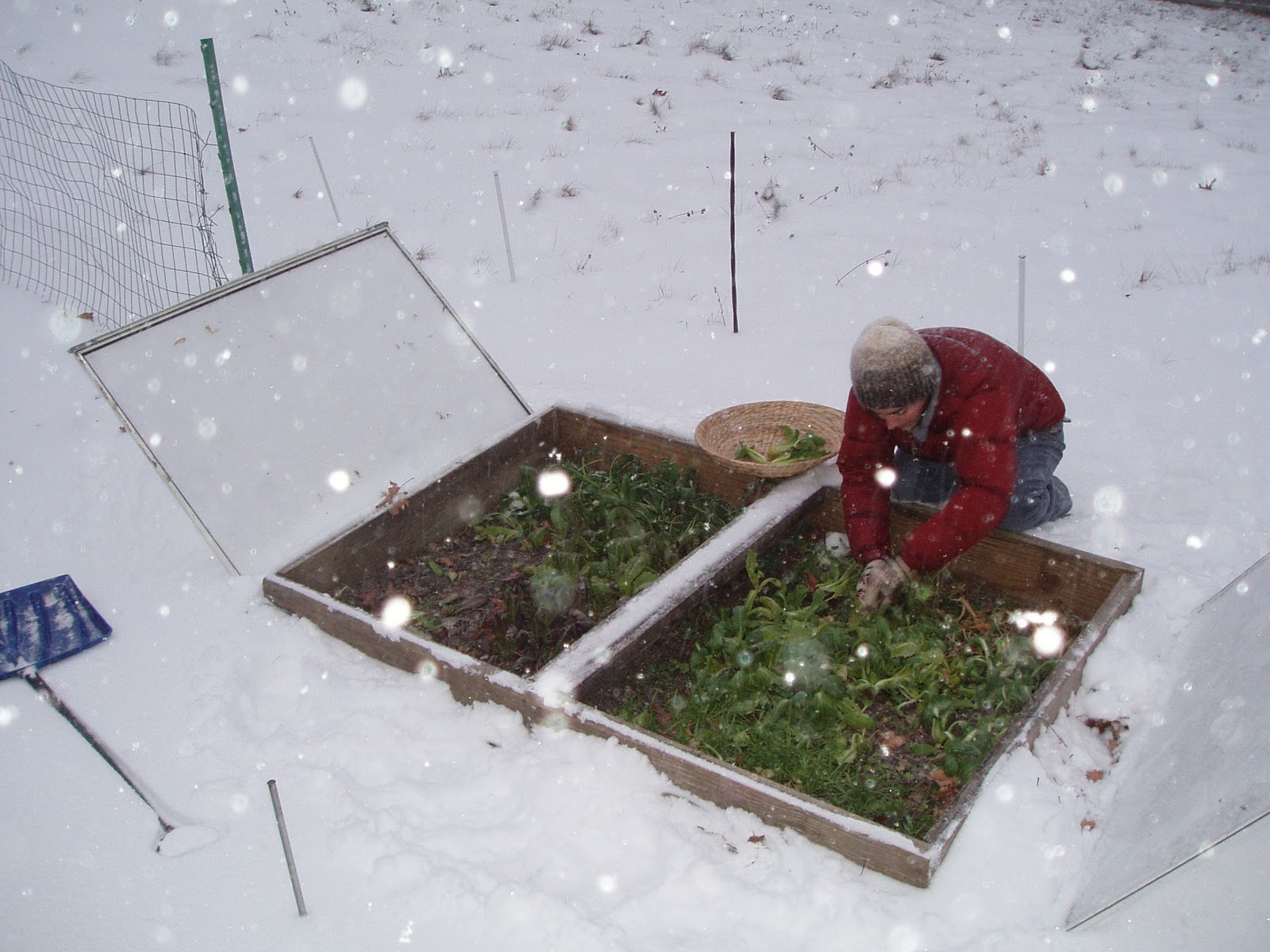
Coldframe - end of December

I decided to harvest the last of the greens from the coldframe - mostly going for the bok choy as that recovers well from a hard freeze.  We made a simple stir-fry for dinner last night with the bok choy, tofu and a julienned kohlrabi.  The coldframes were almost an afterthought this year and we didn't cover them, the wood wasn't insulated and the glass was single-pane, fitting poorly with some gaps.  We also were using up old seed and didn't have great germination on the cold-tolerant varieties, so I transplanted summer varieties to fill in the space.  All in all - a good showing as we ate lettuces and salads as well as raab and bok choy into the end of December.  As a comparison I'm uploading an earlier and later fall photo of the same coldframe:

Coldframe - end of October

Coldframe - end of November